WASTE INCINERATION, RECYCLING
AND DISPOSAL
Introduction
Waste disposal was until recently an easily overlooked
problem for several reasons:
Historically, a large percentage of waste was disposed of at
the site. This was true of everything from household trash burning and septic
fields to large incinerators operated by industrial facilities and hospitals.
For instance at one time it was estimated that of the approximately 300 million
tons per year of industrial waste generated in the U.S., more than 50 percent
was disposed of on site. Increased regulation of waste incineration and changes
in lifestyles have resulted in a tendency for waste to be centrally accumulated
and processed.
The amount of waste generated per capita has increased. One
example is that in Sweden the amount of household waste increased almost 25% in
a ten year period. Since waste volume generally increases with commercialization
the volume of waste on a global scale is expected to increase exponentially.

As both regulation and scientific knowledge advances, waste
treatment procedures are adjusted. A good example of this is the disposal of
sludge from municipal wastewater facilities. This material which was at one time routinely spread on crops has been determined in some cases to be
inappropriate for that use. (A recent survey indicates that 8.4 million dry tons of municipal sewage sludge are generated
annually. Twenty percent is incinerated, 25.4 percent is land-applied, 6.6
percent is disposed of in the ocean, and 46.4 percent is landfilled.)
There are a variety of methods used to handle our waste
including recycling, land-filling (with and without gas collection), processing
to create biofuels and incineration.
Most people would agree that the solution to the global waste
problem is not disposal, but reduction of waste. However, that and government
regulations and incentives affecting waste treatment philosophies are beyond the
scope of this report. Globally, incineration is a common waste disposal
procedure. Many existing facilities (except in Europe and the U.S.) have ESP
equipment for emission remediation. As regulations change fabric filtration is
expected to be used in those applications.
Landfill Alternate
Waste to Energy
The success of the WTE Industry has varied. Currently,
government issued tax incentives and the need for alternate energy sources have
improved the financial viability of WTE facilities. However, it should be noted
that using lifecycle analysis there has not been a clear answer as to whether
WTE or landfill is the best option for waste disposal. For instance, a study by
the EU determined that "There is no easy and straightforward answer as to
whether incineration or landfill disposal is preferable..."
The prime subject of this
section is the incineration of waste specifically in waste to energy processes.
According to Covanta Energy one ton of trash produces 600kw of energy as
compared to 75-100kw per ton of energy that can be reclaimed at a landfill
methane collection system. In every environmentally sensitive application, efforts are made to assure that
all materials that can be reasonably removed from the waste stream for recycling
are separated and processed.
The cost of fuel (including
transportation) for power generation varies from 20 to 45% of production cost.
Waste represents a low cost alternative whether for co-firing with other fuel or
in a waste to energy application.
Regulations Affect
the Viability of WTE Operations
In almost every case, regulations governing waste disposal
and processing are primary drivers of the WTE market. For instance, in the
1970's the Public Utility Regulatory Policies Act which mandated that utilities
must pay alternate energy producers their avoided cost of energy allowed the
industry to obtain a higher price for their energy than they might have obtained
otherwise. This led to an increases in the production of energy from alternative
sources. In the early 1990's when Clean Air Act restrictions were enacted the
number of waste incineration facilities in the U.S. was near 1,100. Within
a decade more than 90% of the facilities were no longer operating. Although in most cases
environmental laws are becoming more restrictive, green incentives and other
government subsidies and regulations sometimes affect in the marketplace. There are many waste stream sources including municipal
solid waste (MSW), industrial waste, agricultural waste and waste generated by municipal waste water treatment
facilities. In addition, existing landfills are being "mined" for valuable waste
which might include both materials that can be recycled and materials which
might be used as fuel. Methane gas from decomposing products in landfills is
used to generate heat or power. Waste tires are a large individual waste stream
with more than 1billion tires being disposed of globally each year
(approximately 300 million in the US.)
Government subsidies or incentives are often used to
encourage the development of processes perceived to be beneficial to the
local or even global welfare. In the case of WTE the increase in legislation and regulation controlling
landfills and the related shortage of landfill options has worked in concert
with incentives to the WTE industry to focus
investment in the WTE industry. For instance, in the U.S., operators of the Lee County WTE
facility have been able to sell Renewable Fuel Credits (RFC.) The recent yearly
income of approximately $1M has allowed them to process waste competitively with
local landfills.
Cap and Trade Regulations Will Impact Both Landfill and WTE Operators
Landfill Cap and Trade
A “cap and trade” system is premised on the fact that the emission of green
house gases (GHG) is almost unavoidable (or at least economically imperative)
for some industries. At the onset of any program maximum levels (caps) of GHG
emission are established for emitters. Those entities that produce excess
greenhouse gases and those that destroy or sequester them can “trade” “credits.”
The assumption is that some entities can reduce emissions or destroy GHGs more
cheaply than others and a free market would encourage resources to flow to the
most advantageous GHG reduction technologies or strategies, indirectly financing
renewable strategies.
The US House of Representatives passed a “cap and trade” bill in 2009. Although
the fate of US cap and trade is unknown the EU and others are already using this
type of system and it is expected that the US will eventually adopt some sort of
framework for trading carbon credits.
Both the science and the economics underlying this type of legislation is hotly
debated. Proponents and critics alike say the carbon credit market could be
lucrative. Some analysts predict that the market could be worth as much as $700
billion by 2013.
Voluntary carbon credit trading markets, such as the Chicago Climate Exchange,
already exist. The Chicago Climate Exchange trades Carbon Financial Instruments
(CFIs.) Since its inception, CFIs have traded for as much as $7 (although the
price in early 2010 has generally been in the range of 10 to 15 cents.
California has plans to begin a cap and trade system in 2012. Some members of
the Western Climate Initiative, a consortium of Western states including
California and Canadian provinces, have shown an interest in developing a
regional cap and trade frame-work. (There are indications that the possibility
of establishing this sort of potentially expensive, binding agreement has led to
fractures of the alliance.)
The degradation of organic waste produces a significant amount of methane. Both
landfills and WTE processes destroy GHGs and as such could generate carbon
credits. This could create financial incentives for these industries.
For instance, flaring off methane produces water and carbon dioxide. Although
CO2 is also a GHG methane absorbs more of the sun's infrared radiation than
carbon dioxide. Flaring methane destroys it (ie reduces a greenhouse gas
emission) and potentially generates carbon credits that could be sold or traded.
(One CFI equals 100 metric tons of carbon dioxide equivalent. The EPA defines
carbon dioxide equivalent as a measurement unit used to compare the emissions
from various greenhouse gases based upon their global warming potential.)
Regulations Relating
to Emissions Will Impact WTE
The increasing cost of complying with environmental
legislation has led to an acceleration of the trend to use our trash to generate
electricity, provide heat and reduce the production of methane gas which would
be created were the trash installed in landfills. Facilities which produce heat
and electricity are referred to as Combined Heat and Power (CHP.) Producing heat
and electricity from municipal waste has the advantage of providing a fuel
source close to the power or heat consumer thus reducing both transportation and
transmission costs.
Utilizing MSW as a fuel has several disadvantages. The waste
is generally bulky and heterogeneous. Combustion facilities can be either "mass burn" or utilize
refuse derived fuel. Combustion facilities can operate more efficiently if they
use refuse derived fuel (RFD) which is the material which is produced after
waste is processed to recover recyclables (ie metals, glass and cans) and then
shredded or pellatized. Some statistics indicate that over one-fifth of US
municipal waste incinerators use this type of fuel. The heterogeneous nature of
the fuel makes it more difficult to optimize the combustion process. More
expensive and advanced air pollution control equipment is required to assure
that environmental restrictions are met.
Mercury emissions from incineration can be a significant
problem. A coal fired boiler might have emissions in a range from 6.8 to 24.0
µg/m3. Natural gas
produces mercury emissions at or below detectable levels. By comparison the
mercury concentrations associated with incinerators range from 39 to 700
µg/m3. Mercury emissions from waste combustion are caused largely by
the inclusion of batteries, thermometers, electronics, fluorescent light bulbs
and other products in the waste stream. Waste handlers have attempted to reduce
mercury emissions by public education efforts aimed at preventing mercury
containing items from entering the waste stream (ie recycling and reduction of
mercury in consumable products.) Activated carbon injection is used to control
mercury in the gas exhaust stream.
HCl emissions are considered to be a key issue in waste
incineration applications. The injection of sodium sorbents has proven to be an
effective control technology. As with any injected material, the residence time
is crucial for removal. Injection upstream of a baghouse allows the filter cake
to serve as a secondary reaction point (the baghouse serves as a reaction
vessel) marketedly improving removal efficiency.
Studies by Vogg and Stieglitz (1986) showed that particulate
carbon can react with oxygen and inorganic chlorines with copper (II) as a
catalyst to form organochlorine compounds including dioxins and furans, and
concluded that this de novo synthesis is the primary source of dioxins/furans
produced in municipal waste incineration.
Solid Waste Combustors
Types of Incinerators
Commercially available incinerators fall into 3 categories:
rotary kilns, grates and fluidized beds. Rotary kilns and grates can accommodate
a wider range of waste input but operate at a higher temperature. Fluidized be
incinerators require a uniform sized waste (typically RFD) but have better heat
recovery and are easier to control when the caloric value of the waste input
varies.
A Typical WTE Incineration Facility
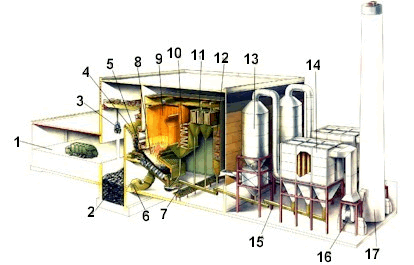
1.
2.
3.
4.
5.
6. |
Tipping Floor
RefuseHolding Pit
Grapple Feed Chute
Feed Chute
Stoker Grate
Combustion Air Fan |
7.
8.
|9.
10.
11.
12. |
Ash Discharger
Combustion Chamber
Radiant Zone (furnace)
Convection Zone
Superheater
Economizer |
13.
14.
15.
16.
17. |
Dry Gas Scrubber
Baghouse
Fly Ash Handling System
Induced Draft Air Fan
Stack |
Waste Disposal Using Gasification Processes
Gasification is a process that
converts carbonaceous materials, such as coal, petroleum, biofuel, or biomass,
into carbon monoxide and hydrogen by reacting the raw material, such as house
waste, or compost at high temperatures with a controlled amount of oxygen and/or
steam. The resulting gas mixture is called synthesis gas or syngas.
The syngas is composed of hydrogen, carbon
monoxide and some methane. The syngas is then used as a fuel for the production
of heat and/or steam for electricity. In other
words, gasification is a method for extracting energy from many different types
of organic materials.
As early as the 17th century street
lighting and cooking gas were produced in this manner. Currently gasification is
used on industrial scales to generate electricity from coal or petroleum (ie.
fossil fuels.) The fact that almost any type of
organic material can be used as the raw material for gasification makes it a
candidate for waste disposal.
The advantage of gasification is that using the syngas is potentially more
efficient than direct combustion of the original fuel because it can be
combusted at higher temperatures. Syngas may be burned directly in internal
combustion engines, used to produce methanol and hydrogen, or converted into
synthetic fuel. In addition, the high-temperature combustion refines out
corrosive ash elements such as chloride and potassium, allowing clean gas
production from otherwise problematic fuels.gasification itself and subsequent
processing neither directly emits nor traps greenhouse gasses such as carbon
dioxide.
Combustion of syngas or derived fuels emits the exact same amount of carbon
dioxide as would have been emitted from direct combustion of the initial fuel.
Biomass gasification and combustion could theroetically play a role in a
renewable energy economy, because biomass production could remove the same
amount of CO2 from the atmosphere as is emitted from gasification and
combustion. While other biofuel technologies such as biogas and biodiesel are
carbon neutral, gasification in principle may run on a wider variety of input
materials and produce a wider variety of output fuels.
Power consumption in the gasification and syngas conversion processes may be
significant, and may indirectly cause CO2 emissions. Gasification relies on
chemical processes at elevated temperatures >700°C. Typically the elevated
temperatures are produced using electrically powered plasma heating
elements.Several of the gasification processes currently available use more
energy than is produces (therefore using them to destroy hazardous waste is
logical; using them for pwer production does not make economic sense.)
Gasification uses the principles of combustion, but the conditions are
controlled so that they remain sub-stoichiometric, that is to say one part of
the reaction is at a level less than required for the perfect reaction. In the
case of gasification, the oxygen levels are kept purposefully low so that the
combustion reaction only gets to the volatilization stage where combustible
gases are produced.
The low level of oxygen ensures that these gases cannot combust themselves to
complete the combustion reaction where all energy in the waste materials is then
spent. The syngas generated can then be tapped off and used as a fuel.
A $225M facility planned by Alliance Federated Energy of Milwaukee could be
the first commercial waste disposal facility using gasification technology in the U.S..
The 25-megawatt project would go online in 2013, and would deploy a plasma
gasification technology developed by Westinghouse Plasma Corp.
A planned facility in
the UK will use gasification
Pyrolysis
Like gasification, pyrolysis is a thermal reaction with
restricted air or Oxygen. Gasification, however, is exothermic and requires a higher
operating temperature. Pyrolysis (with no added O or air) is endothermic;
lower temperatures avoid the production of dioxins. Both processes are currently
used for hazardous waste.
Refuse Derived Fuel
Most facilties use Refuse Derived Fuel (RDF.) RDF is
typically made by compacting combustible products such as papers and plastic
into "balls" approximately 3/4 inch in diameter. A typical waste recycling
facility produces 55% by weight RDF (ie the other 45% of waste is either
recycled or inappropriate for RDF use.)
Approx 4,800 kcalories per 1kg (2.2 pounds) of waste.
Approx 1kg of waste is equivalent to 500 liter (132
gallons) of petroleum.
Approx 1 ton of RDF to produce 1 MW power.
Hospital Waste Incineration
Hospital Waste Incineration is a specialized field due to
infectious and hazardous components of the waste.
Hospital Incineration
Literature Archive